
For current SPINS service availability, prices and staffed hours, contact your location.
Last Updated: October 28, 2026
Quick Summary
To protect delicate clothes, hand-wash them in cool water with a mild, pH-neutral detergent, or use the delicate cycle with low spin and a small load. Always follow the care label, use fine-mesh laundry bags, and air-dry by laying knits flat and hanging silk and lace on padded hangers.
- Hand washing delicate clothes takes about 15 minutes of active work.
- Silk should be washed in water below 85°F with pH-neutral, enzyme-free detergent.
- Wool and cashmere need water below 100°F and should never be agitated.
- Fill mesh bags about two-thirds full at most to avoid overstuffing.
- Keep the washer no more than half full on the delicate cycle.
Table of Contents
- Why Delicate Clothing Needs Special Care
- Identifying Delicate Fabrics and Reading Garment Care Labels
- Step-by-Step: Hand-Washing Delicate Items Safely
- Machine-Washing Delicates: Delicate Wash Cycle Settings Explained
- Choosing the Best Detergent for Delicate Clothes
- Using Mesh Laundry Bags for Delicates
- How to Dry Delicate Clothes Without Stretching or Shrinking
- Troubleshooting: Shrinkage, Color Bleeding, Pilling, and Stretched Shapes
- Frequently Asked Questions
Why Delicate Clothing Needs Special Care
Delicate clothes are garments made from fine fibers or fragile construction that break down under heat, friction, or harsh chemicals. Silk, wool, lace, cashmere, and lightweight synthetics all fall into this group. Protecting them starts with understanding what a normal wash actually does to them.
Most of that damage is preventable.
What Causes Damage in a Normal Wash
A regular cycle combines four forces that fine fabrics cannot handle well:
- Heat shrinks wool and warps synthetic fibers
- Agitation stretches knits and pulls threads loose
- Spin speed distorts shapes and causes tangling
The Federal Trade Commission's clothing care guidance notes that following a garment's care label is the single most reliable way to avoid damage. Ignore the label, and you accept the risk.
Delicate clothing needs special care because the fibers are thin, the weaves are loose, or the trim is fragile. For a deeper look at everyday delicate workwear, see our guide on how to wash delicate work clothes.
Identifying Delicate Fabrics and Reading Garment Care Labels
Knowing which items are delicate is half the battle. Check the fabric content tag first, then the care label, and then use the fabric-specific rules below to decide how to wash, dry, and treat each piece.
Treat these as delicate:
- Silk, wool, cashmere, and mohair
- Lace, mesh, and sheer fabrics
- Items with beads, sequins, or embroidery
Fabric-by-Fabric Care Rules
Generic "gentle cycle" advice fails because silk, wool, and lace each fail in different ways. Use this as a decision guide:
| Fabric | Water Temperature | Detergent | Wash Method | Drying |
|---|---|---|---|---|
| Silk | Cold (below 85°F) | pH-neutral, no enzymes | Hand wash or fine-mesh bag on delicate cycle | Hang on padded hanger, away from sun |
| Wool and cashmere | Cool to lukewarm (below 100°F) | Wool-safe, no enzymes | Hand wash; never agitate | Roll in towel, reshape, lay flat |
| Lace | Cold | Mild, no bleach | Hand wash or fine-mesh bag | Lay flat on a towel |
| Rayon and viscose | Cold | Mild, no enzymes | Hand wash or delicate cycle; avoid prolonged soaking | Hang or lay flat; rayon weakens when wet |
| Lightweight synthetics (polyester blends, nylon) | Cool | Standard mild detergent | Delicate cycle in mesh bag | Low-heat tumble or hang dry |
A common pattern is that natural protein fibers (silk, wool) react worst to heat and enzymes, while regenerated fibers like rayon lose strength when wet and should never be hung heavy.
Decoding Care-Label Symbols
Care labels use a standard set of symbols. A tub with a hand inside means hand-wash only. A tub with one line under it means a gentle cycle. A tub with an X means do not wash at all.
| Symbol | Meaning | What to Do |
|---|---|---|
| Tub with hand | Hand-wash only | Wash by hand in cool water |
| Tub with one line | Gentle cycle | Use delicate cycle, low spin |
| Tub with X | Do not wash | Dry clean only |
| Square with circle | Tumble dry allowed | Use lowest heat setting |
| Square with X | Do not tumble dry | Air-dry only |
| Iron with one dot | Low heat | Iron inside out, cool setting |
When Not to Machine-Wash
Use these decision rules before any delicate load:
- Hand-wash-only symbol: Do not machine-wash, even on a delicate cycle. The label is telling you the fiber cannot tolerate drum agitation.
- Dry-clean-only symbol (tub with X): Do not wash at home. Dry-clean-only garments often have construction, fused interfacing, structured shoulders, beaded trim, that water can permanently distort.
- No label at all: Treat the item as hand-wash-only in cold water with mild detergent, and air-dry. That is the safest default when the manufacturer's guidance is missing.
When a label says dry clean only, believe it. Machine washing those items rarely ends well, and the damage, fused layers bubbling, beads bleeding dye, is usually permanent.
Reading the Fabric Content Tag
The content tag tells you what the garment is made of; the care label tells you what to do. When they conflict, for example, a "100% silk" tag with a machine-wash symbol, follow the care label, because the manufacturer tested that specific construction.
Federal Trade Commission's clothing care guidance notes that following a garment's care label is the single most reliable way to avoid damage. Ignore the label, and you accept the risk.
Step-by-Step: Hand-Washing Delicate Items Safely
Hand washing is the safest method for delicate clothes, and it takes about 15 minutes of active work. Here is the process we recommend:
- Fill a basin with cool water. Lukewarm is fine for wool; cold is best for silk.
- Add a mild detergent. A capful is plenty. Swirl it in before adding clothes.
- Submerge the garment gently. Press it down; never wring or twist.
- Soak for 5 to 10 minutes. Do not leave silk sitting longer than that.
- Rinse in clean cool water. Repeat until no suds remain.
- Press out water with a towel. Roll the item in a dry towel and press. Never wring.
- Reshape and lay flat to dry. Block knits back into shape while damp.
A common mistake is rubbing stains hard. On delicate fabrics, blot instead. Friction breaks fibers and creates permanent fuzz.
Machine-Washing Delicates: Delicate Wash Cycle Settings Explained
A delicate wash cycle uses low agitation, cool water, and a slow spin to clean fine fabrics without the mechanical action that causes damage.
Set these controls before you start:
- Cycle: Delicate or gentle
- Temperature: Cold or cool water
- Spin speed: Low, or no spin if available
The American Cleaning Institute's laundry room guidance recommends washing small loads on gentle settings to reduce friction between items. That matters most for delicates.
If you would rather skip the guesswork, our pickup and delivery service.
Choosing the Best Detergent for Delicate Clothes
The best detergent for delicate clothes is a mild, pH-neutral formula with no enzymes, bleach, or brighteners. Look for "gentle," "free and clear," or "silk and wool safe" on the label.
Avoid these ingredients:
- Enzymes, which break down protein fibers like silk and wool
- Bleach and optical brighteners, which fade color
- Fabric softener, which coats fibers and reduces breathability
Use less than you think you need. Excess detergent leaves residue that stiffens fine fabrics and traps odor.
If you want a gentler option for the planet too, our guide on eco-friendly laundry covers low-impact detergents and habits.
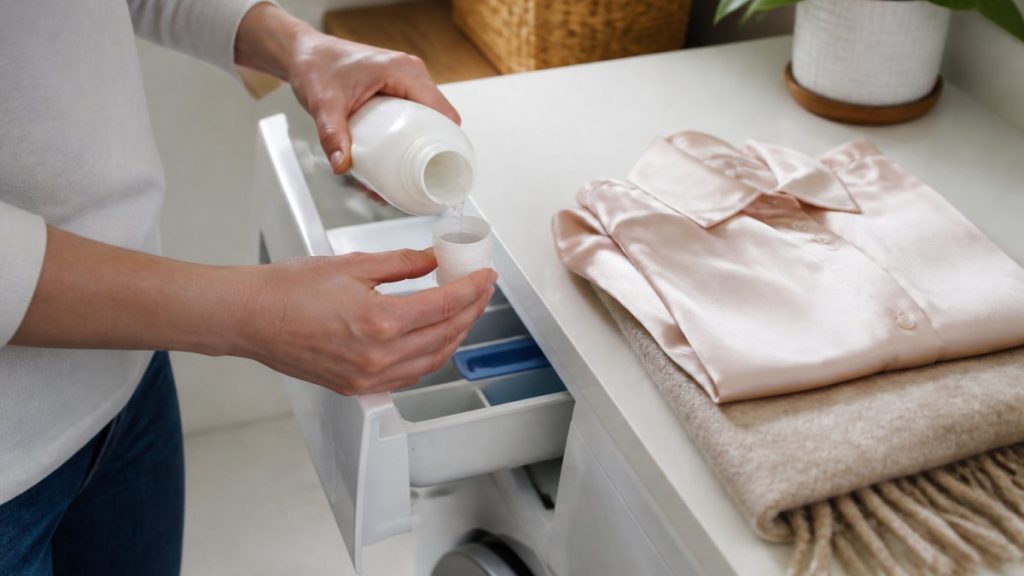
Selecting a gentle, enzyme-free formula prevents the breakdown of fragile fibers, which remains the most effective way to keep clothes looking new throughout their entire lifecycle.
Using Mesh Laundry Bags for Delicates
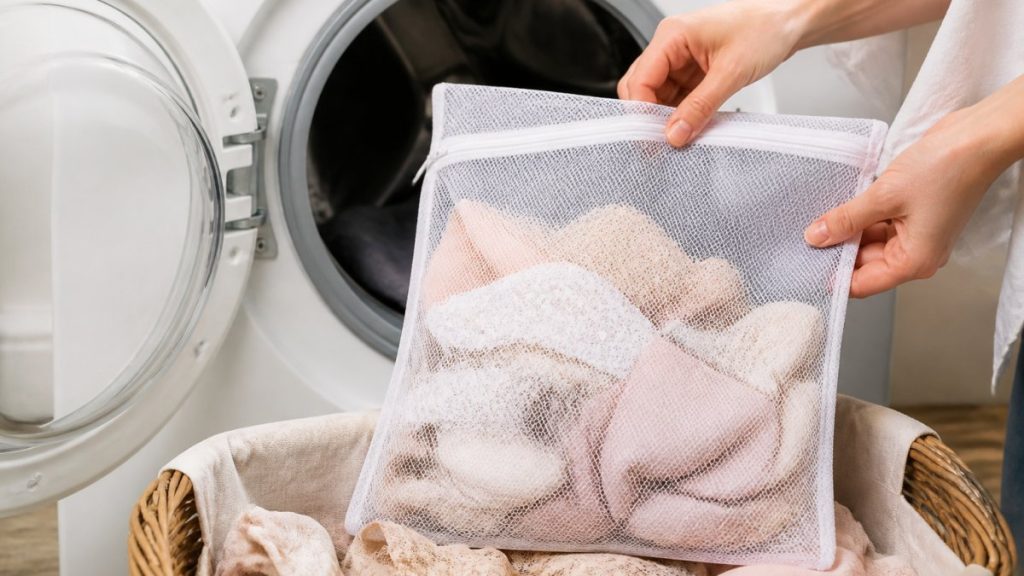
Mesh laundry bags are the cheapest protection you can buy for delicates, but most advice stops at "use a bag." The details, mesh size, bag dimensions, closure type, and what goes in together, are what actually prevent snags, tangles, and stretched straps.
Match Mesh Size to Fabric and Trim
Mesh is measured by the size of the openings, and the right choice depends on what could snag or escape:
- Fine mesh (often sold as "lingerie" or "delicates" mesh) has small openings that keep lace, hosiery, and bra straps from poking through. Use it for anything with hooks, clasps, or loose trim.
- Medium mesh is the general-purpose choice for silk blouses, lightweight synthetics, and knit tops.
- Coarse or heavy-duty mesh suits sweaters and thicker knits where you want more water flow and less compression, but it offers less snag protection, so reserve it for items without exposed hardware.
A common pattern is to keep one fine-mesh bag dedicated to lingerie and one medium bag for blouses, so you are not sorting every load.
Pick a Bag Size That Lets the Garment Move
A bag should hold the item with room to spare, roughly two-thirds full at most. As a rule of thumb:
- Small bags (about 12 x 16 inches) fit one bra, a pair of hosiery, or a few pairs of underwear.
- Medium bags (about 16 x 20 inches) fit one silk blouse, a camisole, or two lightweight tops.
- Large bags (about 20 x 24 inches or bigger) fit one sweater or a small group of knit items.
If a bag is stuffed, the fabric cannot move freely, detergent cannot rinse through, and the bag itself becomes a friction source. Overstuffing is the single most common mesh-bag mistake.
Choose the Right Closure
- Zippers are the most secure and the easiest to inspect for a full close. Tuck the pull tab into the elastic guard so it cannot catch other garments.
- Drawstring closures are gentler on very fine fabrics but can loosen in the wash; double-knot them.
- Snap or button closures are convenient but can pop open. Avoid them for anything small enough to escape.
Before the bag goes in the drum, run a finger along the closure to confirm nothing is exposed.
Load Bags by Compatible Pairs
Group items that can safely share water, agitation, and dye transfer:
- Bras together, hook-and-eye closures can snag other fabrics, so keep them in one fine-mesh bag with the hooks fastened.
- Silk and lace together in a fine-mesh bag, sorted by color.
- Sweaters alone in a large bag, one per bag if the knit is heavy.
Bag Placement in the Drum
Do not cram every bag into one corner. Distribute bags around the drum so the load stays balanced, and keep the total load small, no more than half full. A balanced drum spins more smoothly, which means less stress on the bag contents.
Label your mesh bags with a laundry marker ("lingerie," "silk," "sweaters") so the whole household loads them correctly without sorting every time.
Planning your supplies and routine? You can review our service pricing before you decide between home washing and drop-off.
How to Dry Delicate Clothes Without Stretching or Shrinking
Air-drying is the default for delicate clothes. Heat is what shrinks wool and warps synthetics, so keep tumble drying to a minimum.
Use these drying methods:
- Lay flat to dry knits, wool, and cashmere on a clean towel
- Hang dry silk and lace on padded hangers to avoid shoulder marks
- Roll in a towel first to remove excess water before hanging
If you must use a dryer, choose the lowest heat setting and remove items while still slightly damp. Never hang a wet wool sweater by the shoulders; the weight stretches it out of shape.
Troubleshooting: Shrinkage, Color Bleeding, Pilling, and Stretched Shapes
Damage is not always permanent. Act fast and some problems can be reversed or reduced.
- Shrinkage: Soak wool in cool water with a little conditioner, then gently stretch it back to shape and lay flat.
- Color bleeding: Rinse immediately in cold water. Do not dry until the dye stops running.
- Pilling: Use a fabric shaver or a fine comb to lift the pills. Wash inside out next time.
Prevention beats repair. Sort delicates separately, use mesh bags, and always check labels. If a piece is badly damaged or the label says dry clean only, professional dry cleaning is the safer route.
Frequently Asked Questions
Is it okay to wash all clothes on delicate?
No. The delicate cycle uses slower agitation and a gentler spin, which won't clean heavily soiled items like towels, workout gear, or jeans effectively. Reserve it for delicate clothes such as silk, wool, lace, cashmere, and fine synthetics. Wash sturdy items on a normal cycle, and separate delicates from heavy fabrics like denim that can snag or abrade them in the drum.
Should delicate clothes be washed in a mesh laundry bag?
Yes, mesh laundry bags for delicates are one of the simplest ways to prevent snagging, stretching, and tangling. Bras, lingerie, and small items should always go in a bag to keep them from catching on zippers or wrapping around other garments. Choose a fine-mesh bag for lace and silk, and avoid overstuffing so water and detergent can circulate freely through the fabric.
Can you put delicate clothes in the dryer?
Usually not. Heat and tumbling are the fastest ways to shrink wool, warp silk, and stretch knits out of shape. Check the care label first: if it shows a dryer symbol with a line through it, air-dry only. Even dryer-safe delicates do better on the lowest heat setting or a no-heat air fluff. For most delicate clothes, hang dry or lay flat on a drying rack away from direct sun.
What detergent is best for delicate fabrics?
A mild, pH-neutral liquid detergent made for delicates is the safest choice for silk, wool, and cashmere. Avoid powder detergents, which can leave residue, and skip anything with bleach or heavy enzymes that break down protein fibers. Use the smallest amount recommended, since excess detergent leaves stiff residue. If you have sensitive skin or special detergent requests,
Protecting delicate clothes takes a few extra minutes, but it saves garments you would otherwise replace. Spins Laundromat makes that easier with eco-friendly detergents, state-of-the-art equipment, and flexible drop-off wash & fold. Our pickup and delivery service puts expert care on your schedule. Get started with Spins Laundromat and keep your fine fabrics looking new.
